The biggest enemy of summer getaways is not always on the road
Summer is the favourite season for thousands of travellers who enjoy getaways in a camper, van or motorhome.
The days are longer, holidays allow for longer routes and the good weather encourages you to discover new places.
However, it is also the time of year when one of the most common problems appears: heat build-up inside the vehicle.
Many travellers arrive at their destination, park in a spectacular spot and, when they return several hours later, are faced with an unpleasant reality: the interior feels like an oven.
The worst part is that this heat does not disappear immediately when the sun goes down. In many cases, it continues to affect comfort for a large part of the night.
That is why learning how to control the interior temperature can make the difference between a comfortable getaway and an uncomfortable night trying to fall asleep.
Why Does a Camper Get So Hot When Parked?
Although it may seem obvious, understanding the reason helps you make better decisions.
Glazed surfaces allow solar radiation to enter, which quickly heats up the interior of the vehicle.
Once inside, much of that heat becomes trapped, creating an effect similar to that of a greenhouse.
For this reason:
- The steering wheel can reach very high temperatures.
- Interior furniture accumulates heat.
- Mattresses and textiles heat up.
- The interior air takes a long time to cool down.
Even when the outside temperature starts to drop, the interior continues to release the heat accumulated throughout the day for hours.
That is why it is far more effective to prevent the vehicle from heating up than to try to cool it down afterwards.
The Mistake Almost Everyone Makes: Only Thinking About the Night
When someone plans a summer getaway, they usually worry about how they will sleep.
However, the real problem starts much earlier.
If the vehicle spends several hours exposed to the sun without protection, it will reach the evening with a large amount of accumulated heat.
At that point, even if you open the doors and windows, the heat will still remain in:
- Windows.
- Interior panels.
- Mattresses.
- Furniture.
- Upholstery.
That is why more experienced travellers start managing the temperature from the very moment they park.
How to Reduce the Interior Temperature from the Moment You Park
Look for shade, but do it strategically
Shade is the simplest and most effective solution.
However, not all shade works in the same way.
Sometimes, partial shade in the morning disappears completely by midday.
Before leaving the vehicle parked for several hours, it is advisable to observe how the sun will move throughout the day.
A tree, a wall or a building can provide protection for much longer than it may initially seem.
Take the vehicle’s orientation into account
This small detail often goes unnoticed.
Depending on how the camper is positioned, some glazed surfaces will receive more direct solar radiation than others.
If you have the option to choose, try to minimise the exposure of the most heavily glazed areas during the hottest hours of the day.
It may seem like a minor detail, but it helps significantly reduce the accumulated heat.
Ventilate before the heat builds up
One of the most common mistakes is waiting until the interior is already hot before trying to ventilate.
Whenever possible, encourage air circulation from the very beginning of the day.
The less heat that builds up during the day, the easier it will be to maintain a comfortable temperature when night falls.
The Importance of Protecting Glazed Surfaces
Windows are one of the main points through which heat enters.
That is why many experienced travellers pay special attention to this area.
Good protection on the windows helps to:
- Reduce direct solar radiation.
- Maintain a more stable temperature.
- Improve privacy.
- Reduce glare.
In addition, during the summer, this protection can also help make the interior space much more pleasant during rest periods.
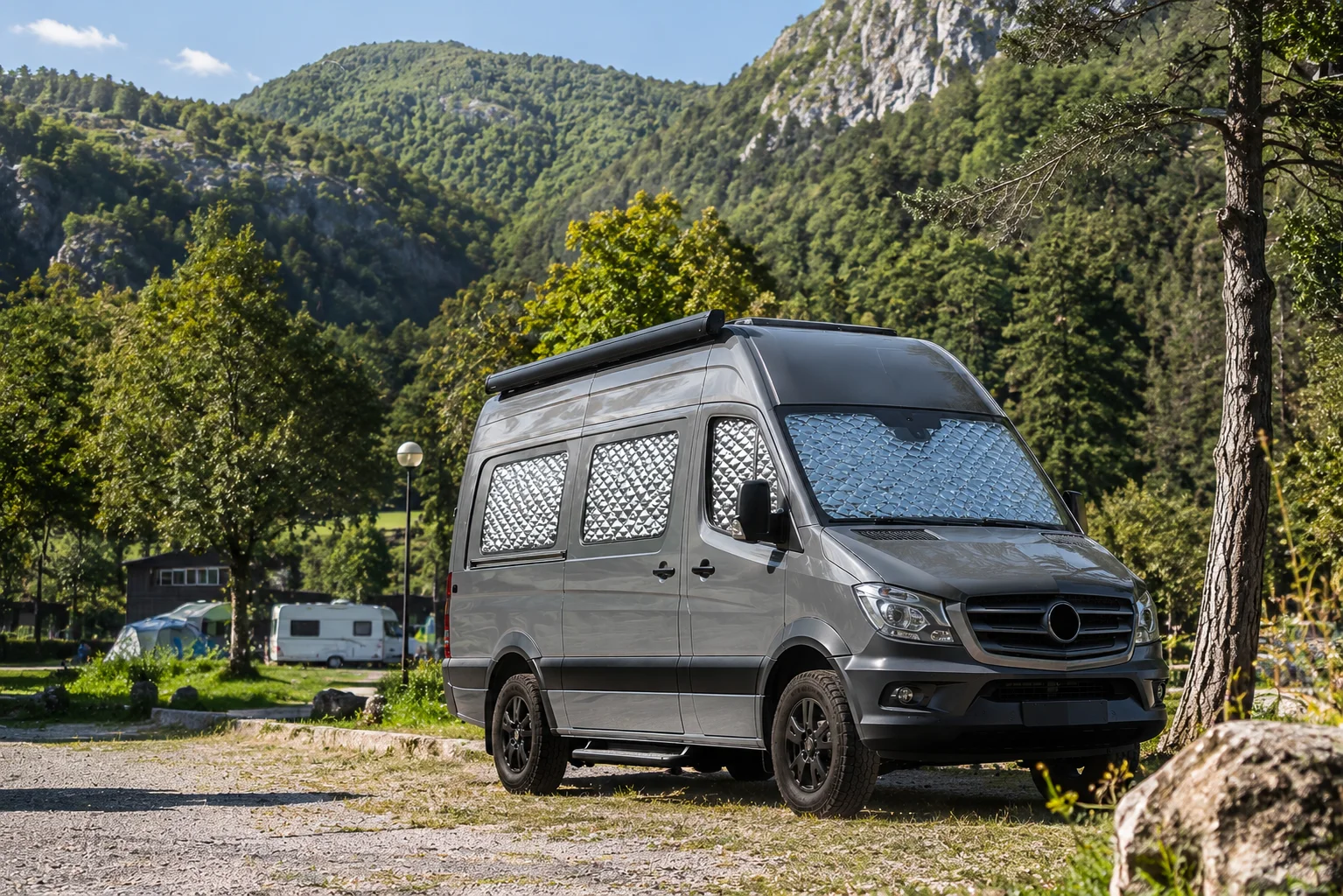
In this regard, thermal insulators for campers are a very useful solution for limiting heat entry through the windows and improving interior comfort.
What to Do When You Cannot Find Shade
Sometimes, that simply is not an option.
Beaches, motorhome areas or certain car parks may offer very few sheltered spots.
In these cases, it is advisable to:
- Make use of any partial shade available.
- Minimise direct exposure of the windows as much as possible.
- Ventilate properly whenever it is safe to do so.
- Use solutions that limit heat entry.
The key is to minimise the amount of thermal energy that enters the vehicle during the hottest hours of the day.
How to Prepare Your Camper for Better Sleep After a Hot Day
When the afternoon arrives, the goal is to remove the accumulated heat as quickly as possible.
Some simple measures can help a lot:
Create cross ventilation
Allowing air to circulate from one side of the vehicle to the other speeds up the renewal of the interior air.
Avoid additional sources of heat
Cooking inside the camper during the hottest hours of the day can increase the interior temperature even further.
Prepare the sleeping area
A clean, well-ventilated space protected from outside light always promotes better rest.
In addition, having custom-made camper mattresses can help create a more comfortable sleeping area tailored to the vehicle.
Small Changes That Make a Big Difference in Summer
Many times, there is no need to make major modifications to improve the travel experience.
Small decisions such as:
- Choosing carefully where to park.
- Managing shade.
- Reducing sun exposure.
- Protecting the windows.
- Maintaining good ventilation.
They can completely transform comfort inside the vehicle.
And when it comes to multi-day trips or long holidays, these differences are much more noticeable than they may seem.
FAQs
Is it normal for a camper to remain hot several hours after sunset?
Yes. Interior materials accumulate heat during the day and release it gradually throughout the night.
Does shade really make that much of a difference?
Yes. Avoiding direct sunlight exposure for several hours can significantly reduce interior heat build-up.
Are windows the main source of heat entering the vehicle?
In most vehicles, yes. Glazed surfaces receive a large proportion of direct solar radiation.
How can I sleep more comfortably in a camper during a heatwave?
A combination of shade, ventilation, sun protection and a suitable sleeping area usually provides the best results.
Enjoying summer on the road should not mean having to endure heat inside the vehicle.
At M2Camper, we manufacture custom-made thermal insulators to help reduce heat entry, improve privacy and increase comfort on any getaway. Discover the solution tailored to your vehicle and get ready to travel more comfortably throughout the summer.